
B Corp Application Process for Canadian Businesses
B Corp Application Process for Canadian Businesses
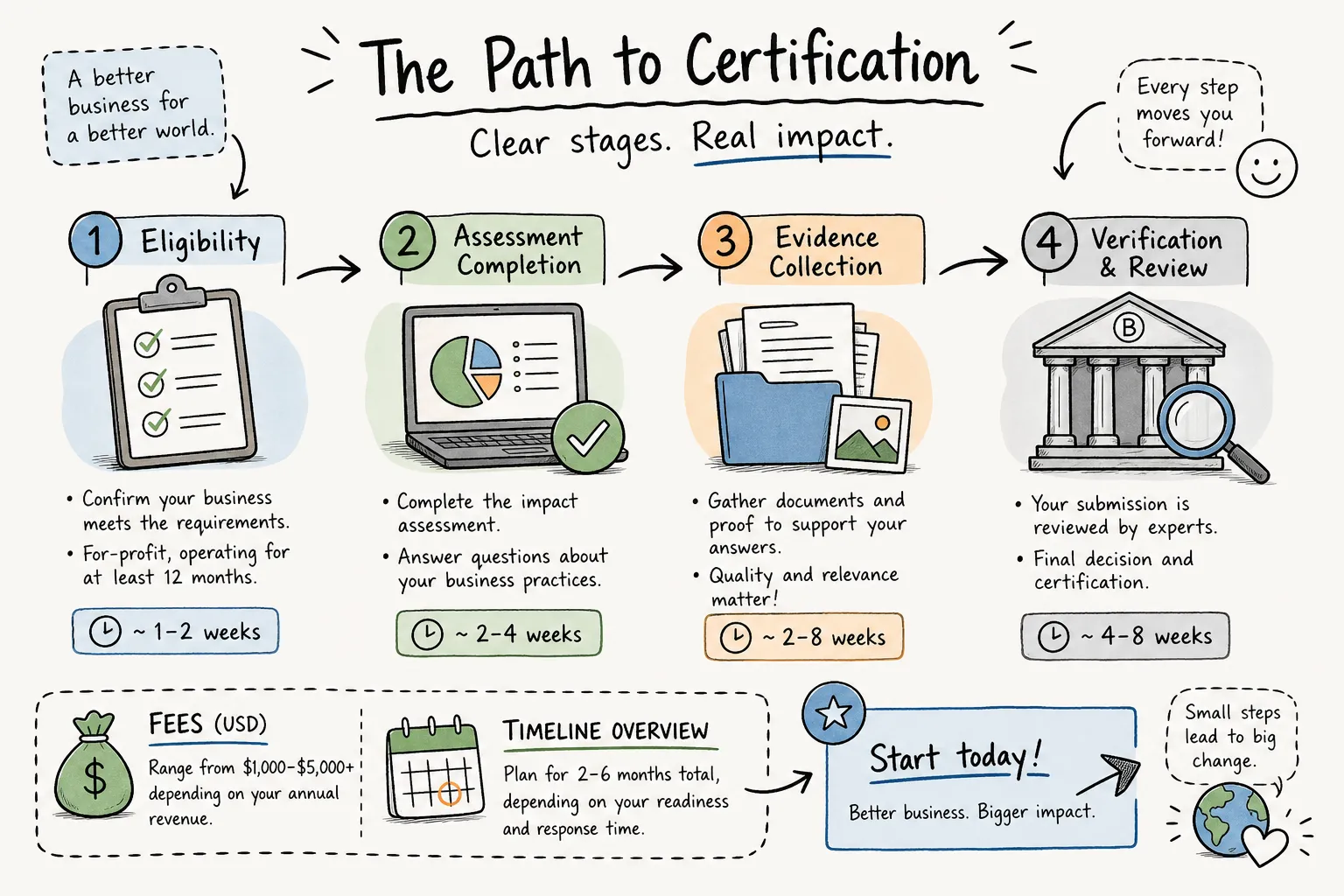
The B Corp certification application has four distinct stages: confirming eligibility, completing the B Impact Assessment, gathering evidence that holds up under independent review, and navigating verification. Tools like BeReady exist precisely because tracking what you've collected, what's still missing, and what needs a paper trail is genuinely half the battle. By the end of this article, you'll know exactly what to expect at each stage, what it costs, and what legal changes your Canadian company will need to make before you're done.
B Corp application process: Who qualifies in Canada
Before you register for the B Impact Assessment, confirm your business actually meets the entry requirements. Getting this wrong early wastes months of effort and sets expectations your company can't meet.
The baseline requirements every applicant must meet
To be eligible, your company must be a for-profit entity that has been operating for at least 12 months, incorporated in a jurisdiction B Lab serves, and not operating in an excluded industry. You also need to be genuinely willing to measure, improve, and report on your social and environmental performance, not just check boxes.
The most important benchmark is the 80-point minimum score on the B Impact Assessment. That number sounds achievable until you realize most companies score between 40 and 55 points on their first run. The 80-point threshold is not a starting point; it's a finish line that requires real practice and preparation to cross.
When your structure needs a closer look
Certification happens at the company level, not at the brand or division level. If your business operates multiple lines under one entity, B Lab evaluates the entire company, which matters when different divisions have very different environmental or social footprints. Subsidiaries and multi-national structures often require additional review, especially at higher revenue levels.
Non-profits and organizations funded primarily by government or charitable sources are not eligible. Social enterprises and co-operatives frequently ask about this. If your organization operates as a for-profit entity and meets the other criteria, you're likely eligible, but it's worth confirming your structure with B Lab's eligibility guidance before investing significant time in preparation.
How to set up and complete the B Impact Assessment
The B Impact Assessment (BIA) is a free tool, and creating your account is straightforward. What trips companies up isn't the registration; it's showing up to the questionnaire unprepared.
Creating your account and scoping your assessment
Sign up at the B Impact Assessment platform, complete multi-factor authentication, and set up your account with your company details. From there, you'll work through a scoping setup that asks about your company's size, sector, industry, and location. This scoping step is more important than it looks: the platform uses your inputs to filter 130-plus requirement areas down to the ones that actually apply to your business.
Get your scoping inputs right from the start. An error here changes which questions you face throughout the entire assessment, and correcting it mid-process is disruptive. Before you proceed, double-check your sector and size selections against B Lab's definitions to make sure the questions you're answering are actually the right ones for your company.
What the B Impact Assessment actually measures
The BIA covers five impact areas: workers, community, environment, customers, and governance. Each area contains weighted questions, some of which are standard and some of which are sector-specific based on your scoping setup. There are also mandatory disclosure and background-check questions that every company must answer regardless of their overall score. These questions flag issues that can disqualify a company outright, so don't skip them or answer them casually.
The realistic time commitment
The questionnaire itself takes two to three hours for a typical small business. That estimate only holds if you already have your documentation organized. For an SME without an existing system for tracking environmental and social data, gathering the underlying information can take close to 100 hours. Build that preparation time into your project plan; this is not a weekend task.
Building evidence for the B Corp application process
B Lab doesn't take your word for it. Once you submit, a verification analyst reviews a sample of your answers and requests documentation to back them up. This is where under-prepared companies stall, see their scores reduced, and sometimes miss the 80-point threshold entirely.
What B Lab's verification team actually asks for
Common evidence types include employee handbooks, payroll registers, profit and loss statements, supplier lists or supplier codes of conduct, sustainability or annual reports, revenue breakdowns, and energy or resource-use tracking data. For calculation-based answers, B Lab wants the raw data behind the metric, not just the final number you entered. For policy-based answers, doing the activity is not enough: the policy must be documented and available to the relevant stakeholders. Primary sources are the standard wherever possible, a summary document or a verbal confirmation won't satisfy the verification team.
Why organization matters more than you think
Verification calls happen on a defined timeline, and documents need to be uploaded before the review, not during it. If even one selected answer option lacks individual supporting evidence, B Lab can deselect it, which reduces your score. Every option you select within a question must be supported independently. That's not a minor detail; it's the most common mechanism by which companies fall below 80 points during verification despite having strong practices.
This is the exact problem BeReady is built to solve. It organizes your evidence by requirement, gives you a live red/amber/green view of what's confirmed versus what's still missing, and keeps everything audit-ready throughout the process, not just in the week before you submit. Scrambling at the last minute is avoidable with the right system in place from the start.
B Corp application process timeline and fees
The financial and governance side of B Corp certification catches many Canadian businesses off guard. Here's what to budget and what to prepare legally before you get too far into the process.
What the submission and verification process looks like
Once you've completed the BIA and gathered your documentation, you submit your application. After submission, B Lab staff complete an intake review and assign your file to a verification analyst. The analyst selects a sample of your answers for verification and sends a document request list. You then participate in one or two review calls to walk through your evidence, clarify answers, and address any gaps the analyst identified. After the call, B Lab finalizes your score and issues a certification decision.
For a typical small Canadian company, the full timeline from submission to certification decision runs between six and eight months. Seven months is a practical planning estimate, though delays are possible if your evidence file is incomplete or if the review queue is backed up.
Common reasons applications are delayed or scores are reduced
- Missing or late document uploads before the review call
- Evidence that doesn't match the claim, such as a payroll file that omits bonuses or a policy that was never formally documented
- Selecting multiple answer options for a single question without independent evidence for each one
- Sensitive documents that require redacting, which creates additional back-and-forth with the analyst and extends the timeline
What B Corp certification costs in Canada
There are two separate costs to plan for. The one-time submission fee ranges from US$150 for companies with annual revenue under US$500,000 to US$900 for companies over US$100 million. The annual certification fee starts at US$2,100 for companies with revenue up to US$5 million and scales from there. A small Canadian business under $5 million in revenue should budget approximately US$2,250 total for the first year: US$150 submission fee plus US$2,100 annual certification fee.
These fees recur annually, so factor them into your operating budget alongside the time investment, not just the initial project cost. The annual certification fee applies every year you remain a certified B Corp.
The governance changes Canadian companies must make
B Lab requires all certified companies to amend their governing documents to include stakeholder-consideration language. Directors must formally consider the interests of employees, suppliers, the community, and the environment, not only shareholders, when making decisions. For most Canadian corporations, this means amending your articles of incorporation and passing a special resolution with at least two-thirds shareholder approval under the CBCA or applicable provincial legislation.
After shareholder approval, you file Articles of Amendment with Corporations Canada or your provincial registry. The amendment is only official once the Certificate of Amendment is issued, so don't treat shareholder approval alone as the finish line. You technically have one year after certification to complete this amendment, but the smarter move is to initiate it during the application process, not after you've already received your certification. Some structures, such as credit unions, may also need to amend their by-laws with member approval. Build this governance work into your project timeline early.
Your B Corp readiness checklist: From eligibility to certified
The B Corp application process follows a logical sequence: confirm eligibility, complete and score the B Impact Assessment, collect primary-source evidence for every selected answer, submit, go through verification, and meet the legal requirement. That's the full picture. The complexity lives in the execution.
Most stalls and score reductions come from documentation gaps, not from poor business practices. Companies that already do the right things by their employees, communities, and environment often fall short during verification simply because they never formalized or organized the proof. The performance was there; the paper trail wasn't.
Following the B Corp application process end-to-end, and treating it as an ongoing management system rather than a one-time project, puts you in a stronger position for both initial certification and recertification under the new, more rigorous B Lab standards. That's what BeReady is built for: keeping your evidence organized, your readiness visible, and your team aligned from your first BIA question through to verified certification and every renewal that follows.