
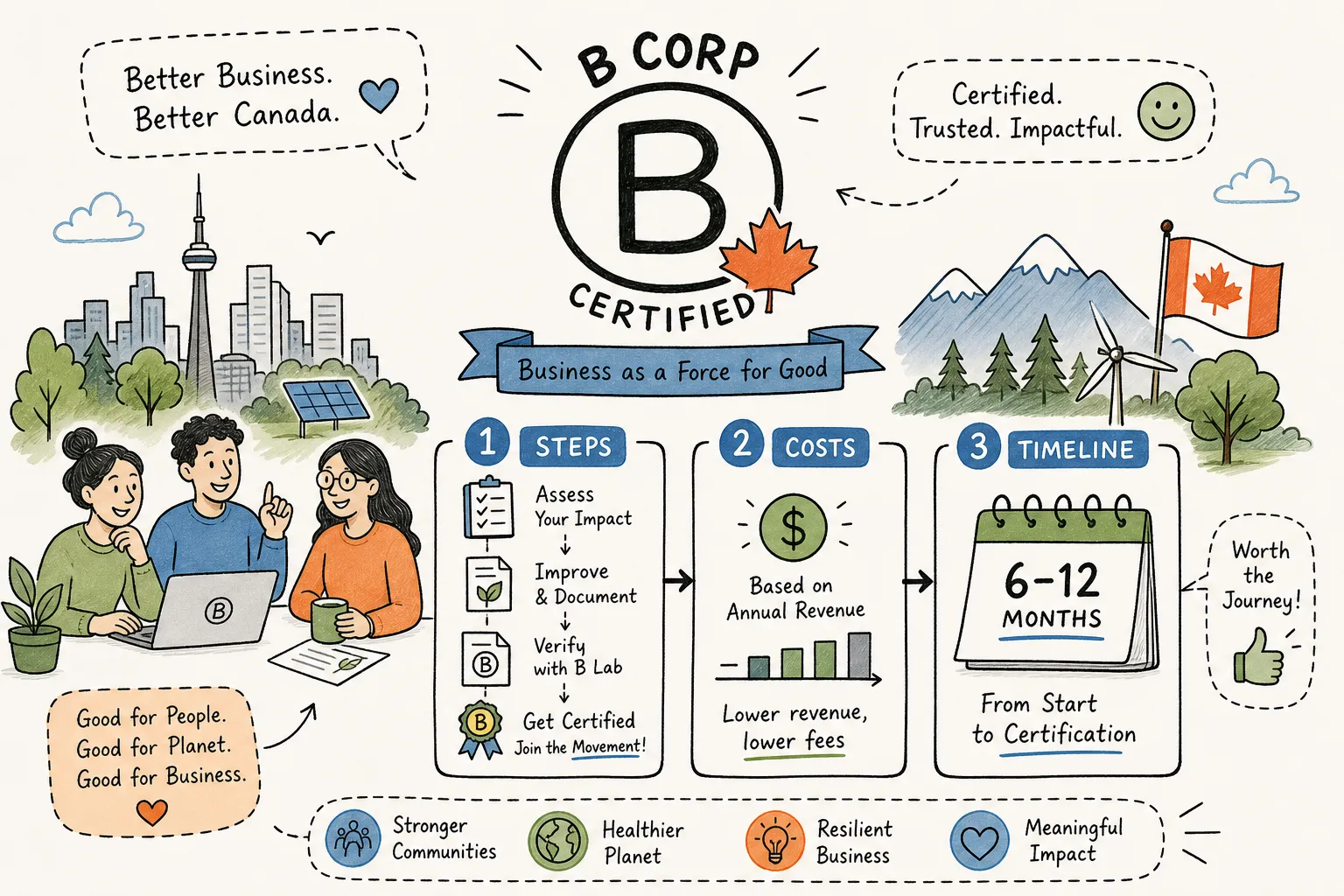
B Corp Certification in Canada: Steps, Costs, and Timeline
Pursuing B Corp certification in Canada has become a real strategic priority for a growing number of businesses. Canada now has over 400 certified B Corporations, and that number reflects a genuine shift in how Canadian businesses think about accountability, talent, and competitive positioning, not a fringe statistic. Yet the moment most business owners start researching how to actually pursue certification, the complexity becomes apparent fast: a rigorous independent audit process, detailed documentation requirements, and legal amendments to governing documents.
BeReady was built to help Canadian small businesses navigate this process, because the gap between wanting certification and knowing exactly how to get there is real and significant. This article bridges that gap. By the end, you'll know whether your business qualifies, what the B Corp certification process looks like step by step, what it costs, and what legal changes you'll need to make.
What B Corp certification actually means for Canadian businesses
B Corp certification is not a membership, a pledge, or a logo program. It's an independently audited certification issued by B Lab that verifies a company's social and environmental performance against a rigorous global standard. Companies that earn it have met a verified minimum score across five impact areas, workers, community, environment, customers, and governance, and every claim behind that score is subject to documentation review.
Think of it as a business credential, not just a values statement. Research from Toronto Metropolitan University (2023) found that employees at certified B Corps are 45% more likely to report high job satisfaction, and certified companies are 6x more likely to offset 100% of their greenhouse gas emissions. Those are operational outcomes, not marketing claims. Canadian companies in provinces like British Columbia, Ontario, and Quebec are particularly well-positioned for this credential because the business culture in those regions already aligns strongly with B Corp values around people, planet, and transparent governance.
The five impact areas the B Impact Assessment measures
The B Impact Assessment (BIA) evaluates performance across five pillars:
- Workers, compensation, benefits, training, and workplace culture
- Community, local economic impact, supplier relationships, diversity practices, and charitable giving
- Environment, resource use, emissions, supply chain impact, and environmental management systems
- Customers, whether the company's core product or service creates measurable positive value for the people it serves
- Governance, transparency, accountability, and how the company's mission is protected through legal and structural commitments
Together, these five pillars give B Lab a complete picture of whether a company is performing well across the full scope of its operations.
Why Canadian businesses are well-suited to B Corp values
Food and beverage is the most common industry represented among Canadian B Corps, but the range is broad: professional services, technology, eco-services, retail, and financial services all have a meaningful Canadian presence in the B Lab registry. What ties most of these businesses together is that many were already operating with strong people-and-planet values before they ever heard of B Corp. The certification process doesn't ask them to become something different. It asks them to document and verify what they're already doing, which is a more honest description of the actual challenge involved.
Who qualifies: the eligibility basics before you begin
Before spending weeks on the BIA, confirm your eligibility. The core criteria are straightforward: your business must be for-profit, must have been operating for at least 12 months, must not operate significantly in an excluded industry, and must be a complete and distinct business entity rather than a brand or division of a larger company. Many Canadian small businesses meet these basic eligibility criteria without issue.
The 80-point threshold and what it signals about readiness
The minimum verified score required for B Corp certification in Canada is 80 points. That sounds achievable until you learn that many companies score well below that on an initial assessment. The gap is real, and closing it requires deliberate, sustained work. The BIA includes many questions, but not all of them apply to every business. B Lab scopes the relevant questions based on your company's size, sector, and workforce composition, so the assessment you complete is tailored to your situation rather than a one-size-fits-all exercise. Reaching 80 is not about perfection; it's about demonstrating verified, consistent practice across multiple impact areas.
Structures and situations that add complexity
For the typical Canadian small business owner with under 50 employees and a single location, the eligibility path is relatively clean once the 12-month and for-profit criteria are confirmed. Additional review requirements apply if your company has over $100M in revenue, operates in more than five countries, has more than 10 subsidiaries, or operates in more than two industries. If none of those apply, you're working with the standard process.
How to get B Corp certification in Canada: the process from first step to approval
The certification journey has a clear arc: complete the BIA, submit for verification, move through B Lab's review queue, respond to verification questions, and receive a final certification decision. Understanding each phase helps you plan your time and resources realistically rather than being caught off guard partway through.
Completing the B Impact Assessment
The BIA is a free tool available on B Lab's website, and you can start it without any commitment. The tool itself is not the challenge. The challenge is gathering the documentation and evidence behind each answer, which means pulling records from across your business: HR policies, payroll data, supplier contracts, environmental reports, and governance documents. For a small team, this phase can take anywhere from a few hours to several weeks depending on how organized your existing records are.
The verification queue and what B Lab reviews
After submitting, companies enter an evaluation queue followed by a verification queue. For small to medium-sized businesses, B Lab's current guidance puts the full review cycle at roughly 6 to 8 months. During verification, B Lab reviewers contact the company with specific questions and evidence requests. Responding quickly and completely keeps your file moving. Disorganized documentation is the most common cause of delays at this stage, because reviewers need verified proof, not just answers.
From conditional certification to final approval
After verification, B Lab may issue a conditional certification that requires corrections or additional evidence before final approval is granted. Once the threshold is confirmed and the legal requirement is in place, B Lab issues the certification. Companies then sign the B Corp Agreement and pay the annual certification fee to go live in the B Corp directory. This final step moves relatively quickly once the substantive review is complete.
What B Corp certification costs in Canada
The cost structure has two parts: a one-time $150 submission fee when you apply, and ongoing annual certification fees tied to your revenue. The B Lab fees are the easier part to budget for. The harder cost is internal time, which for an understaffed small business can span months of scattered effort across multiple roles. Both deserve a line in your planning.
The annual fee schedule by revenue tier
Annual certification fees are based on your most recently closed fiscal year's gross revenue. Here are the most relevant tiers for Canadian small businesses (2026 B Lab fee schedule):
| Annual revenue | Annual certification fee |
|---|---|
| $0, $5,000,000 | $2,100 |
| $5,000,001, $7,500,000 | $3,150 |
| $7,500,001, $10,000,000 | $3,938 |
| $10,000,001, $15,000,000 | $6,300 |
| $15,000,001, $20,000,000 | $8,925 |
Subsidiary structures add per-entity verification fees ranging from $500 to $5,000 depending on the subsidiary's revenue and review type. For most Canadian small businesses under $5M in revenue, the annual fee sits at $2,100.
The real cost most businesses don't budget for
Time is the hidden cost of B Corp certification. Gathering evidence, completing BIA questions, managing the legal amendment, coordinating staff confirmations, and responding to B Lab's verification requests can add up to dozens or even hundreds of hours spread over 6 to 12 months. Many companies report that this time burden lands on whoever has the bandwidth that week when there's no dedicated sustainability manager or operations lead, which creates inconsistency and delays. First-timers consistently underestimate this piece of the puzzle.
The legal changes your Canadian business needs to make
B Corp certification requires companies to embed stakeholder governance into their legal documents. Your governing documents must state that the company's purpose includes creating a positive social and environmental impact, and that directors must consider the interests of a broad set of stakeholders, not just shareholders, when making decisions. For most Canadian corporations, this means amending the articles of incorporation, which requires shareholder approval.
What the articles of incorporation amendment involves
B Lab's required language for Canadian corporations covers five core concepts: a purpose clause committing the company to positive social and environmental impact; a director-duty clause requiring consideration of shareholders, employees, suppliers, creditors, consumers, government, the environment, and the community; a clause clarifying that no single stakeholder group is automatically determinative; a clause limiting new rights for non-shareholders; and a reliance clause protecting directors who act in accordance with the expanded definition of "best interests." This is a legal document change filed with the relevant incorporating authority, not a philosophical statement. It needs to be accurate, properly worded, and correctly filed under the applicable federal or provincial corporate statute.
Timeline for B Corp certification in Canada: shareholder approval and provincial differences
For companies with 49 or fewer employees, the legal amendment must be completed at the time of certification. Companies with 50 or more employees have one year post-certification to complete it. Across most Canadian provinces, the amendment is made to the articles of incorporation via a special shareholder resolution. British Columbia is a notable exception: BC offers a distinct "benefit company" status built into provincial legislation, which satisfies the B Lab legal requirement through a statutory benefit statement and benefit provision rather than the standard articles amendment used in other jurisdictions. A corporate lawyer familiar with B Corp amendments can typically complete the drafting and filing in days to a few weeks once governance approval is secured.
How small Canadian businesses are managing this without burning out
B Corp certification is a genuine operational project, not a form to fill in on a slow afternoon. The businesses that succeed treat it as an ongoing management system rather than a one-time sprint. Most small teams hit their first wall at the evidence-gathering phase, because there's no centralized system for tracking what documentation exists, where it lives, and whether it actually meets B Lab's verification standard.
Where most businesses lose momentum
The common failure points look like this: documentation scattered across email threads, cloud drives, and accounting software with no clear connection to specific BIA requirements; an internal champion leaving the company midway through the process; losing track of progress across dozens of impact areas; and not knowing how close to 80 points the business actually is at any given moment. Without a centralized system, the certification project becomes whoever owns the spreadsheet. That creates fragility, and fragility creates stalled projects.
Why BeReady was built for this process
BeReady is a B Corp readiness platform designed specifically for the post-2024 B Lab standards and built with Canadian small businesses in mind. It automatically captures evidence from the tools your business already uses, including bookkeeping software, cloud drives, and email, so you're not manually re-entering data into a separate system. A live red/amber/green Evidence Builder dashboard shows your readiness across all impact areas in real time, so you always know where you stand relative to the 80-point threshold. Two AI advisors are available on demand: The Assessor for standard interpretation and The Archivist for business-specific evidence guidance. BeReady is Canadian-hosted, which supports data sovereignty and is relevant for businesses operating under Canadian privacy requirements. Evidence and project history are stored in the platform rather than with individual employees, protecting your institutional knowledge through staff changes.
Your next step: find out where you stand now
B Corp certification in Canada is achievable for small businesses. It requires honest preparation, a realistic timeline of at least 6 to 8 months, a clear understanding of the legal steps involved, and a budget that accounts for both B Lab fees and internal time. These aren't barriers designed to discourage you. They're the structure of a certification that actually means something when you earn it.
The businesses pursuing this credential are already trying to do right by their people and their community. The certification is the formal recognition of work that's already underway. What it demands is the documentation and systems to prove it at the standard B Lab requires.
The best first move is a B Corp readiness assessment so you can see exactly where your business stands before committing to the full process. BeReady's readiness tools walk you through that gap analysis and show you precisely which impact areas need the most attention. Start there, and the path to B Corp certification in Canada becomes a lot clearer.