
B Corp certification cost: the real numbers for 2026
Most people searching for B Corp certification costs expect to find a single number. B Lab's published fee schedule makes it look almost affordable, and technically it is. The submission fee for a small Canadian business can be as low as $150. But that's not your budget, and mistaking it for one is one of the most common planning errors we see.
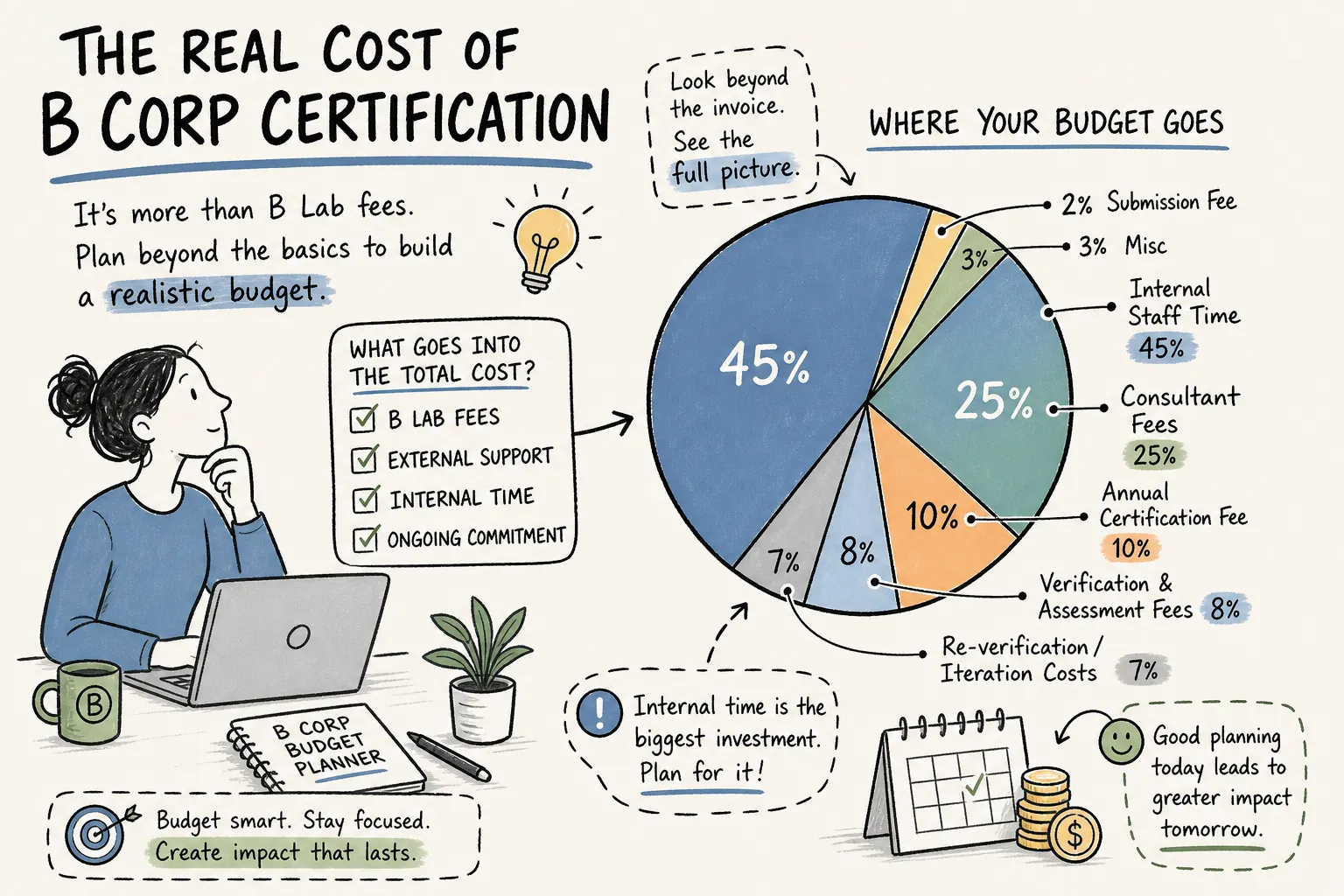
The cost of B Corp certification for Canadian small businesses is more than B Lab's invoice alone. When we talk to Canadian business owners preparing for certification, the number that always surprises them isn't the B Lab fee. It's the stack of costs underneath it: verification charges, internal staff hours, potential consultant fees, and the re-verification rounds that happen when evidence isn't organized from the start. This article breaks down every cost layer so you can build a budget that reflects what certification actually requires in 2026, not just what B Lab charges on paper.
Submission and annual fees
B Lab U.S. & Canada operates two separate fee categories: a one-time submission fee and an annual certification fee. Both are based on revenue, but they serve different purposes and hit at different points in the process.
The one-time submission fee
The submission fee is paid when you formally submit your company for certification. It's a one-time charge, and for most small Canadian businesses, it's the smallest line item in the entire budget. The real budget work begins with the annual fee and the costs underneath it.
| Annual revenue | Submission fee* |
|---|---|
| $0, $500K | $150 |
| $500K, $4.9M | $250 |
| $5M, $49.9M | $500 |
| $50M, $99.9M | $700 |
| $100M+ | $900 |
* (USD; Canadian applicants are charged in CAD, confirm current treatment with B Lab U.S. & Canada at time of application)
The annual certification fee you'll pay every year
Once certified, the annual certification fee recurs based on your gross revenue from the most recently closed fiscal year. This is the fee that maintains your certification status and your right to use the B Corp trademark. According to B Lab U.S. & Canada's FAQ, Canadian applicants are charged annual fees in Canadian dollars at a 1:1 conversion from the published USD amounts, confirm the current treatment directly with B Lab at the time of your application, as currency policies can change.
| Revenue range | Annual certification fee |
|---|---|
| $0, $5,000,000 | $2,100 |
| $5,000,001, $7,500,000 | $3,150 |
| $7,500,001, $10,000,000 | $3,938 |
| $10,000,001, $15,000,000 | $6,300 |
| $15,000,001, $20,000,000 | $8,925 |
| $20,000,001, $30,000,000 | $12,600 |
| $30,000,001, $50,000,000 | $16,800 |
Additional tiers exist above the $50M revenue band; see the B Lab U.S. & Canada fee page for the complete 2026 schedule. These fees apply whether you're operating in BC, Ontario, or Quebec. They're reasonable for what they maintain, but they're not the number most businesses end up focused on once they get deep into preparation.
The extra charges that often get left out of early budgets
Beyond the core B Lab fees, a second tier of charges catches businesses off guard. These aren't hidden, but they're easy to overlook in an early-stage budget.
Verification and assessment charges
For companies submitting under the new B Lab standards that took effect April 1, 2024, verification fees apply as part of the formal evidence review process. The new standards are more rigorous than the old framework, which means more submitted evidence gets formally verified, and that verification comes with a cost. Document verification and review fees run $50 to $520 or more, depending on what's being assessed and the depth of review required. The broader evidence scope under the updated standards means this line item affects more applicants in 2026 than it would have under the previous framework. Budget for it explicitly rather than discovering it mid-process.
Multisite and governance-change fees
If your business operates from more than one location, each additional site may require a separate assessment component, with fees ranging from $100 to $8,400 per site depending on scope. Most small Canadian businesses with a single office won't hit this, but companies with multiple locations or a franchise model need to account for it. Governance or entity changes, name changes, ownership restructuring, or certificate reissues, typically run $0 to $100 for straightforward administrative updates, though costs can increase with complexity.
The biggest cost most budgets completely miss
The official B Lab fees are the visible part of what certification costs. The invisible part is almost always larger. It's realistic for a business that budgets $3,000 for certification to see total costs rise to $20,000 or more, depending on internal time invested and whether outside support is needed, a scenario that plays out regularly for businesses that underestimate the labor component.
Internal staff time adds up faster than the B Lab invoice
Preparing for B Corp certification under the new standards means gathering, organizing, and documenting evidence across all five impact areas: workers, community, environment, customers, and governance. That work falls on your team, not on B Lab. For well-documented businesses, evidence collection and preparation can take 20 to 40 hours. For companies that haven't formalized their practices, that figure climbs to 100 hours or more.
Multiply those hours by your team's fully loaded hourly rate, and the number gets real fast. At a fully loaded cost of roughly $31 per hour for a Canadian small-business employee (a conservative estimate based on Statistics Canada wage data for administrative roles), even 80 hours of certification prep represents about $2,500 in labor before you've paid B Lab a cent. For less-documented businesses or teams running lean, that number can climb well past $10,000 in internal labor alone. This is the cost that can stretch a 6-month certification process into 18 months and still leave you underprepared at submission.
Consultant fees if you bring in outside help
Some businesses hire external B Corp consultants to accelerate the process or navigate the complexity of the new standards. That's a legitimate choice, but it comes with a real price tag. In Canada, limited-scope readiness support packages typically start around $1,000 to $5,000. Full-service preparation engagements run $5,000 to $20,000 for smaller firms, with heavier advisory support for more complex organizations reaching $15,000 to $75,000. These consultant fees are entirely separate from B Lab's own charges.
Consultants can reduce the risk of a rejected submission and save meaningful internal time. The honest framing: skipping consultant support without a structured evidence system usually means more internal hours, not fewer.
Where BeReady changes the math on staff time
The reason internal staff time runs so high under a traditional approach is that evidence collection is manual: spreadsheets, email chains, file searches, and team follow-ups that accumulate over months. BeReady is built specifically for the post-2024 B Lab standards. According to BeReady, its AutoCapture feature connects to tools a business already uses, including bookkeeping software, cloud drives, and email, and automatically maps and organizes evidence in the background, replacing what would otherwise be dozens or hundreds of manual hours.
For many small Canadian businesses, the staff time recaptured through that kind of automation can offset a meaningful portion of the total cost of B Corp certification. It's worth factoring into your planning the same way you'd factor in any tool that eliminates a significant labor cost, compare what you'd spend on internal hours against what a purpose-built system would cost before you finalize your budget.
How the certification timeline drives total cost up
The longer your certification process runs, the more it costs. That's a straightforward relationship, but it's easy to underestimate when you're planning from a best-case scenario.
Typical timelines from submission to certification
B Corp certification timelines vary considerably, but most businesses should plan for 12 to 18 months from starting serious preparation to receiving certification. The actual review period after submission typically runs 3 to 6 months. The preparation phase is where most of the time and cost accumulates, and it's the phase where process efficiency makes the biggest difference.
What re-verification rounds cost in real terms
When B Lab requests additional documentation during the review, your team has to locate, prepare, and resubmit evidence. The most common triggers are missing information, documents that don't directly address the specific requirement, or policies that exist on paper but aren't shown to be embedded in practice. Each of those scenarios sends a team member back into file storage, email archives, or staff coordination workflows.
Businesses without an organized evidence system face a particularly costly re-verification loop: hunting for documents that may not have been saved properly, asking staff to recreate records, or restarting evidence collection almost from scratch for a gap area. Getting your evidence organized before you submit is the single most effective way to reduce re-verification risk, and the cost that comes with it.
How to estimate the total cost of B Corp certification in Canada
With all the cost layers on the table, here's how the numbers stack up for the two business sizes most relevant to Canadian small-business owners considering certification in 2026.
Sample total cost ranges by company size
Under $5M revenue (1, 15 employees): B Lab fees run $150, $250 for the submission fee plus $2,100 for the annual certification fee. Add likely verification charges ($500, $1,500), internal staff time at fully loaded rates (20, 40 hours for well-documented businesses; 40, 100+ hours for less-documented ones), and optional consultant support ($1,000, $10,000). Together, these produce a realistic total range of $5,000 to $25,000 or more in the first year. The wide range reflects how much process efficiency matters.
$5M, $15M revenue (15, 50 employees): Higher B Lab fees, a broader evidence scope, and more staff coordination across the organization shift the realistic range to $15,000 to $50,000 or more, depending on consultant involvement and how efficiently the business manages evidence collection. These are planning estimates based on common patterns, not guarantees. The actual number depends heavily on how organized your existing practices are.
Where to focus your cost-reduction efforts
The B Lab fees are fixed. You can't negotiate them, and you don't need to. Consultant fees are optional, but skipping outside support without a structured preparation system typically shifts that cost to internal labor rather than eliminating it. The one place where deliberate upfront investment pays back directly is your evidence collection process: the more organized and automated it is, the lower your internal labor cost and the lower your risk of re-verification delays.
The most practical starting point is the free B Impact Assessment. Run through it to get a baseline score, identify where your gaps are, and then build your budget based on how far you are from the 80-point certification threshold. Budgeting from a realistic gap analysis produces a much more accurate number than any best-case estimate.
The bottom line on the cost of B Corp certification in 2026
The B Lab fees are genuine and reasonable. They scale with revenue, they're published transparently, and for most small Canadian businesses, they're not the obstacle. What catches businesses off guard is always the labor side: evidence preparation, documentation work, and the internal coordination that runs for months before a submission is ready.
If you're budgeting for certification in 2026, work backward from your team's actual capacity, not just B Lab's fee schedule. The businesses that manage the total cost of B Corp certification most effectively are the ones that eliminate manual evidence work early, through structured internal systems, good consultant support, or purpose-built tools.
BeReady is built specifically for the post-2024 B Lab standards and designed for Canadian businesses that want automated evidence collection without adding another system to manage. If you're at the planning stage, it's worth seeing how much of your projected internal labor cost it can remove from the equation. Explore BeReady and run the numbers for your own situation before you lock in a certification budget.