
B Corp Certification Timeline for Canadian Businesses
Many Canadian businesses that start the B Corp certification process find the b corp certification timeline far longer than they anticipated. B Lab U.S. and Canada is clear in its guidance: the process takes at least 12 months end to end for new applicants. That baseline assumes you know what you're doing and that your evidence is already organized. For most small businesses, neither of those things is true at the start.
The good news is that the path from start to certification isn't complicated once you see it laid out stage by stage. The problem isn't the process itself. The problem is that most businesses don't map it out before they begin, so they get surprised by the queue, scramble during verification, and end up taking longer than they needed to.
This article breaks down each stage of the B Corp certification timeline, gives you realistic timeframes backed by B Lab's own guidance, and points to where delays actually come from. If you want a tool to help you stay organized across every stage without building a new system from scratch, BeReady is built specifically for Canadian small businesses navigating this process under the new B Lab standards.
What the B Corp certification timeline actually looks like
The 12-month baseline most businesses don't plan for
When B Lab says at least 12 months, that's the baseline, not the worst case. The B Corp certification stages break into two distinct phases: pre-submission preparation, which is where most of that time goes, and post-submission review and verification, which typically runs 2 to 6 months once you're in the queue. That post-submission range is B Lab's own guidance, and Canadian businesses should plan around the longer end of it rather than the shorter one.
The number surprises people because completing the B Impact Assessment itself doesn't take that long. According to B Lab guidance, the BIA can be filled out in anywhere from a few hours to several weeks depending on how ready a business is. The time is in everything that supports it: gathering evidence, formalizing practices, building documentation that will hold up under an independent audit. That preparation work is where most businesses underestimate the effort.
A quick map of the four B Corp certification stages
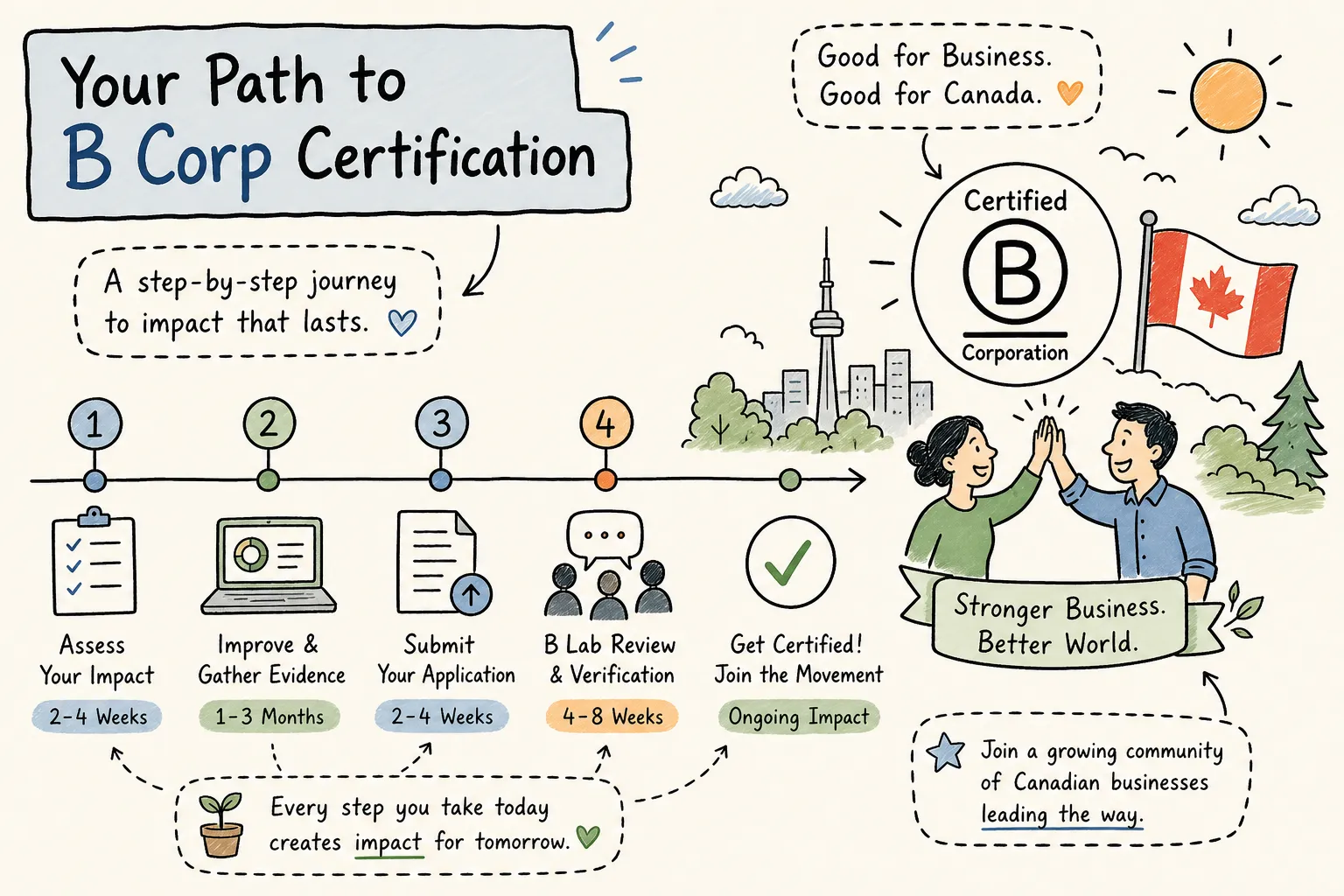
There are four main stages in the B Corp application timeline: completing and submitting the B Impact Assessment, waiting in the review queue and getting assigned an analyst, going through verification and documentation review, and receiving a final certification decision. Each stage has its own timeframe, and each one has its own failure mode. The sections below walk through each one with realistic expectations, not optimistic ones.
Stage 1: Completing the B Impact Assessment
How long the BIA actually takes
For a well-organized business with existing documentation and clear practices, the BIA can be completed in a few weeks. For most small Canadian businesses that are formalizing things for the first time, the realistic range is several weeks to a few months. The questions themselves aren't the hard part. The hard part is gathering the supporting evidence: HR policies, payroll data, supplier documentation, governance records, environmental metrics.
Businesses that are already tracking impact data and have written policies in place move faster. Businesses operating on informal systems move slower. They have to build the documentation before they can answer the questions accurately, and that describes most small businesses starting this process.
Where businesses stall during BIA preparation
Two stall points come up consistently. The first is discovering that informal practices don't meet the documented-policy standard B Lab expects. The second is realizing that certain impact areas require data that was never measured, like energy use, greenhouse gas records, or supplier screening criteria. Both discoveries are fixable, but fixing them takes time, and that time needs to be built into the plan.
The BIA also functions as a diagnostic. A low score in one area is a signal that a business needs to improve its actual practices before submitting, not just its answers. That improvement work adds real time to the process. Businesses that rush through the BIA and submit before they're ready end up paying for it in the verification stage, which is the worst place to discover a gap.
Stage 2: Submission, the review queue, and getting an analyst
The waiting period nobody mentions
After you submit your B Impact Assessment, you don't immediately get assigned to an analyst. There's a queue. B Lab materials describe the wait as up to 2 months before active review begins. This is normal, not a signal that something went wrong. The total post-submission time from queue entry through to a final certification decision typically runs 2 to 6 months, depending on how cleanly the B Corp verification process goes.
Knowing about the queue matters because businesses that don't expect it often interpret the silence as a problem and start second-guessing their submission. It's just B Lab managing volume. The better question is what you do with the time.
What a business should do during the queue
The queue period is not dead time. It's the right window to go back through your BIA answers, shore up any documentation that felt thin at submission, and make sure all your supporting files are organized and easy to locate. Businesses that use this period well enter verification in stronger shape and move through it faster.
Businesses that go quiet and wait for the analyst to initiate contact often scramble when documentation requests arrive. The queue is a gift of time, use it to close gaps before they become problems.
Stage 3: Verification, documentation requests, and the audit
What B Lab actually asks for during verification
Verification means a B Lab analyst reviews your BIA responses and requests primary-source evidence for key answers, especially those marked for documentation or involving formal policies, calculations, or external metrics. Common requests include:
- Employee handbooks and HR policies
- Supplier codes of conduct
- Profit-and-loss statements
- Environmental data and greenhouse gas calculations
- External certifications and contracts
- Employee or stakeholder surveys
- Signed governance documents
For service-based businesses, the focus tends to be on workforce practices, purchasing structures, revenue breakdowns, and stated social or environmental commitments backed by internal records. According to B Lab guidance, the audit component itself typically takes 1 to 10 days depending on company size and complexity. The documentation review surrounding it is where most of the elapsed time sits.
The evidence gaps that create the longest delays
The most common delay in verification isn't a missing document. It's a mismatch between an answer and the evidence provided. B Lab expects documentation that verifies the specific answer option selected, not just general proof that a practice exists. If you selected five options on a multi-pick question, you need supporting evidence for each one. Businesses rarely anticipate this level of specificity.
Redacted documents, informal practices presented as policies, and missing calculations for metric-based questions all generate requests for clarification. Each clarification round extends the timeline by weeks. Nonconformities identified during verification typically require resolution within 3 to 6 months, and multiple rounds of review are common. The businesses that get through this stage fastest are the ones whose documentation was specific, organized, and matched to their answers before the analyst ever asked for it.
What causes delays and how to prevent them
The preparation gap that most businesses discover too late
A common cause of delays in the B Corp certification timeline isn't the verification stage itself, it's decisions made months earlier. Submitting before evidence was genuinely ready, treating the BIA as a questionnaire rather than an audit, or formalizing policies only after realizing the current state won't pass review: all of these push problems downstream. By the time they surface during verification, they're expensive to fix in both time and momentum.
Businesses that spend real time upfront building documentation systems, writing policies that match actual practices, and tracking impact data continuously move through verification faster. Their evidence is already structured the way B Lab expects it. There's no scramble because there's no gap.
Staying audit-ready throughout the year changes the entire timeline
The businesses that move through the B Corp certification timeline most efficiently are the ones that treat it as an ongoing management practice, not a project they kick off six months before they want to be certified. This is the single biggest lever a small Canadian business has over its own timeline. Continuous preparation eliminates the sprint, reduces verification delays, and means you submit when you're genuinely ready rather than when you're hoping it's good enough.
This is what BeReady is built for: keeping Canadian small businesses continuously organized across all certification requirements, so evidence is collected from the tools they already use and they always have a clear view of where they stand across every impact area. When you're audit-ready throughout the year, you don't need to sprint through preparation. You submit cleanly and move through verification without the scramble.
Recertification: the clock starts earlier than most realize
The B Corp recertification timeline and the 6-month submission rule
B Corp certification lasts three years. But B Lab recertification guidance requires submitting an updated B Impact Assessment 6 months before the recertification due date. That makes the effective preparation window 2.5 years, not 3. Most B Corp practitioners recommend starting the recertification process about 15 months before the due date to allow enough time to close gaps, improve practices, and gather fresh evidence under the new standard.
How the new B Lab standard changes the recertification picture
According to B Lab's post-2025 standard materials, the updated framework is significantly more demanding than its predecessor. The old aggregate scoring model allowed a strong performance in one area to compensate for a weak one. That flexibility is gone. Every required impact topic now needs its own documented compliance. Evidence that was acceptable under the old standard may need to be more formally documented now, and practices that passed before may no longer qualify.
For Canadian businesses recertifying under the new standard, the documentation shift is real: from supporting a score to proving compliance with mandatory criteria, with stronger expectations for audit-ready, continuously maintained evidence. Under this framework, starting early is the only path that keeps the process manageable. Businesses that built documentation habits across the full three-year cycle will have a very different recertification experience than those who start from scratch 15 months out.
Map your B Corp certification timeline before you need it
The B Corp certification timeline is manageable, but only if you understand each stage and don't underestimate the preparation work. The 12-month baseline is real. The 2-month queue is real. Verification delays are frequently documentation problems that started months earlier, not problems that begin when the analyst asks for evidence.
The businesses that move through this process efficiently treat certification as a continuous practice rather than a project they start when it feels urgent. That means building the documentation system before the BIA reveals the gaps, formalizing policies against actual practices, and tracking impact data so the calculations are ready when an analyst asks for them.
If you're planning to certify or recertify, map your timeline backward from your target date. Know where each stage sits, build in realistic buffer for the queue and verification rounds, and start building your evidence system now. The businesses that arrive at submission genuinely ready spend the least time waiting for their certificate.